

How To Combine Multiple Mixamo Animations In Maya
Creating Mixamo animations with Blender
The telescopic of work involved in producing a 3d animation is vast, and that studios producing whatever level of animated shorts for Film and Games consist of numerous specialists working on Modeling, Texturing, Rigging, Lighting, and Animation is enough to make a lone creator rock back and along in fetal position while showering, contemplating on how the shampoo foam slowly making its style down the bleed is an apt metaphor for his dreams of ever creating a brusque of his own.
Just lo, the gilded dawn of technological advancements hath come, and like Prometheus' blazing fire numerous software and browser applications now reignite lost hopes of unmarried-handedly creating animated 3d content to one'southward heart'southward….satisfaction. Ane such marvel is Adobe'due south Mixamo, in which you lot tin can upload a mesh to be automatically rigged and animated from a repository of motion capture animations, all for costless and from a browser. Offloading character animation alone could save months of work for most whatever animated filmmaker!
I tried it, and afterwards the first hour of raw excitement, I came to realize that a bunch of ten-2d clips still won't be plenty to create a full curt, permit solitary a few scenes. A character continuing idly and breaking into a run would take two separate clips from Adobe Mixamo, and unfortunately, joining them together isn't enough to sell the movement. I knew using premade mocap would never replicate the beautiful subtleties of professionally hand-animated work, but the jerking result of i clip later another just wouldn't do.
Thankfully, animations with Blender'southward Non-Linear Animation editing system not only allows us to alloy clips merely to as well edit them per transform channel of each bone, making it an excellent way to mix animations and even add a personal flair to them if we were and so inclined.
We'll go through several ways we can utilise the NLA editor equally shown in our Blender tutorial on YouTube to aid us bash Mixamo animations and brand some edits in betwixt.
Collating Animations From Mixamo
Downloading a clip from Mixamo is pretty straightforward, and once you've got your exported format of pick in your local drives, just perform an import operation from within Blender.


In this case, I downloaded and import FBX files. This is Mixamo's default format. The nugget comes in scaled-down ten times. Clearing the calibration using Alt + S. After doing this you lot should run into your asset in the viewport. Rinse and repeat the procedure for all of the clips you programme to use.
Using the NLA Editor

You tin can access the NLA editor by expanding the View Icon as shown above. Select Non-Linear Animation and y'all should see this interface:

The orangish bar represents the keyframes of the Armature you've imported, which, incidentally is named "Armature". Pushing the keyframes downwards by clicking on the icon indicated by the mouse cursor transforms these keyframes into "Actions".
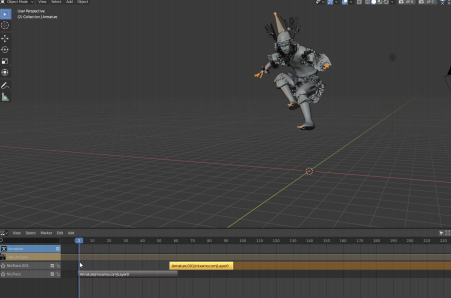
Past repeating these actions for every armature imported nosotros can build a puddle of deportment that we can phone call subsequently on.
Once all our mixamo downloads accept been imported into Blender and saved as actions, we can delete all the armatures except 1.
As long as we create actions from assets downloaded from the aforementioned mesh we brought into our Mixamo blitheness, we can add together them to one of the fbx armatures we imported and so that one armature contains animation data from all the others.

With all our actions saved, we tin add together tracks to our working armature to allow us to position clips ameliorate.

In the prototype above nosotros accept two actions residing in 2 separate tracks that overlap equally they transition into each other. Nosotros'll see why later.
Hither is a common trouble seen in importing mocap data in general:

Detect how as we enter the 2d clip, our character arrives at the starting location as indicated by Blender's 3d cursor instead of starting in that location.
This is where the power of the NLA editor comes into play.
We tin can striking TAB on an action strip to expose its keyframes, substantially entering "edit mode" for that activity strip.

We can switch to the graph editor the same way we got to the NLA editor.

And by entering pose mode on our armature nosotros can select the os in our rig that we would like to make adjustments to.


In this instance, we select the Hip Bone, which is also the root of our armature. The root serves as the Parent to all of the basic. Whatsoever transformation that occurs in this bone affects all the others. We can assume, therefore, that this os is where the motility of our character from point A to B exists.
At this signal, we are going through all the keyframes for every transform channel on JUST the armature's hipbone.

The vertical numbers on the graph editor correspond to the value assigned to the key on a detail frame in time (horizontal numbers are the frame numbers, as in the main timeline).
Because the z location channel's graph is a dramatic spike in value over time, we tin deduce that this channel'southward keyframes represent the grapheme's move forward. (normally in Blender animations this would be the Y-centrality transforms, merely the FBX format recognizes Z as Y and vice versa).
Of course, in many cases, things won't exist and so piece of cake, so some trial and mistake is to exist expected. Tedious, I know, just it still beats mitt animating and refining a single movement over days and days.
At present that we've constitute our keyframes to edit, nosotros can isolate the Z location aqueduct by using shift + h, and by selecting all keys with "a" we tin now motility them up until our character starts the motion from the 3d cursor.

And then we now have our character breaking into a run at the proper position from the previous clip.
Withal, at the frames where the clips transition, nosotros still go a very awkward jump from one stance to another- this gives the feeling of watching someone decision-making a character from a low budget video game
To remedy this, nosotros tin can tab out of the activity strip edit mode in the NLA editor, and in the Strip properties panel, nosotros tin can increase the blend in value from the 2d prune to something above the default 0.

Doing this will cause the keyframes from the previous clip to interpolate to the next, and what was initially a cut from standing to running now becomes a new animation in itself, with the stationary leg moving to take the commencement footstep in the run blitheness.
By entering Pose Mode on the armature and selecting both action clips, nosotros tin search for the Bake Action operation to combine our clips into i set up of keyframes from which nosotros can more easily edit to personalize poses and movements.

This tin be done from the graph editor every bit shown earlier, or even in the dope canvass editor.

And this is how we can turn disparate movements collected from Mixamo into a fluid and new movement for our scenes!
I hope this overview was plenty to pique your interest, and if you'd like to see more Blender blitheness tutorials, have a look at GarageFarm University Youtube Channel.
Happy Creating!
Source: https://garagefarm.net/blog/creating-mixamo-animations-with-blender
Posted by: thomascuslichavy.blogspot.com
0 Response to "How To Combine Multiple Mixamo Animations In Maya"
Post a Comment