

How To Change Background Color In Adobe Animate
Saola Breathing offers groundwork make full styles to modify the groundwork of a scene or an chemical element. In a word, you can fill in a scene or an element with colors or images, or even make information technology transparent. Continue reading to larn more than details nigh these groundwork fill styles and become some tips to utilize them when creating HTML5 animation.
This tutorial covers:
- Filling Background with Solid Color
- Filling Background with Gradient
- Using Image as Background Fill up
- Making Transparent Groundwork
Filling Background with Solid Color
By default, Saola Animate makes scenes completely white and DIVs or shapes bluish. Meanwhile, text elements are made transparent, but it's up to you to customize their background.
To fill the background with a solid color, exercise the following:
Stride 1 : Select a scene or an element.
Step 2 : Click the Backdrop pane > Fill up section. Solid fill up is the 2nd style which defines a solid color for the background.
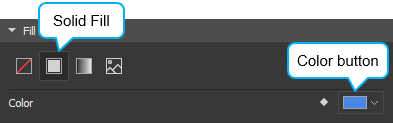
Step 3 : To change the colour, click the Color button. Solid fill up uses the RGBA Colour Picker. The default blastoff (A) is 255.

You lot tin can:
- Pick a color from the default color palette.
- Click More Colors to define custom colors.
- Click Eyedropper to sample a color from anywhere within Saola Animate.
- Drag the alpha slider or click straight on the alpha bar to change alpha value. If alpha is 0, the background fill becomes transparent.
In addition, information technology's possible to animate the background colour. Past default, a colour is made to gradually change into some other. If you want an instant change, right-click a segment and select Remove Transition.
Filling Background with Gradient
Besides setting the background to a solid color, you tin set up it to a gradient. Gradient is a band of ii or more colors in which one color gradually fades into another.
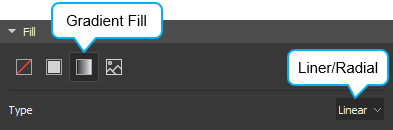
Saola Animate offers two types of gradient fill up:
- Linear gradient creates a direct progression betwixt ii or more than colors. Information technology can go horizontally (left, right), vertically (up, down), or diagonally.
- Radial gradient creates a round progression betwixt two or more colors. Information technology radiates from its heart, either in an ellipse or in a circle.
Linear Gradient
Linear gradient creates a gradual direct-line blending between 2 or more colors. By default, it has two color stops, namely black and white. You can add together as many color stops as you lot want to create unlike linear gradient furnishings.

Have note of the following:
- Gradient strip: Show a "live" sample of the slope. Utilize it to make changes to the slope in a visual manner.
- Color stop: Each color cease on the strip is a distinct color. The selected color stop has a red triangle at the tiptop. To add a color stop, click on the strip or click the Add together button (plus icon). In contrast, click the Remove push (minus icon) to delete the selected color stop.
- Position: Specify the position of the selected color stop where you desire a color to "showtime". For example, the starting colour end has the position of 0%, whereas the catastrophe color stop has the position of 100%. To change the position of a color stop, drag information technology forth the strip or enter a new number in the Position text box.
- Colour: Utilise the Color Picker to define a color for the selected color stop. Gradients support transparency, assuasive yous to create stunning effects. For example, you tin can stack a gradient with a background or stack multiple gradients.
- Angle: Gear up the angle of management for the gradient line. By default, a linear slope runs vertically from bottom to height with an angle of 0 caste. For instance, ninety degree creates a left-to-right horizontal gradient. As the degree increases, the gradient management rotates clockwise. If you set a negative value to the angle, the gradient runs in the counter-clockwise management.
Radial Gradient
Similar to linear gradients, radial gradients create a gradual blending betwixt ii or more colors. Withal, radial gradients radiate from their middle which is chosen a centre point.

Accept note of the following:
- The Gradient strip, Colour end, Position, and Color of radial gradients are much the same as those of linear gradients.
- Shape: Define the shape of the gradient. The value tin can be either ellipse or circle, of which ellipse is the default.
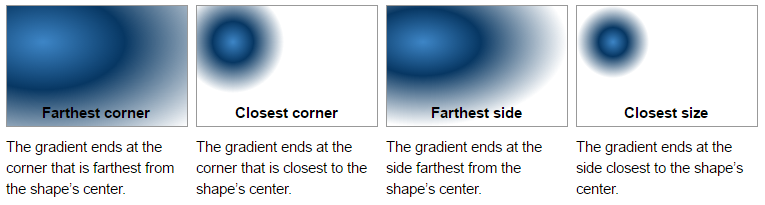
- Size Param: Define the size of the ending shape, in other words, the shape where the last color ends. There are four possible values:
- Origin 10, Y: Adjust the location of the center point. For example, Origin 10, Y [value: l%, 50%] sets the gradient in the heart (default). Meanwhile, Origin Ten, Y [value: 0%, 0%] sets the gradient to get-go in the top left. Y'all can breathing these properties to create animation where the center point moves from this position to that position.
Note: Saola Animate is compatible with Chrome 4+, Firefox 3.5+, IE 9+, Edge, Safari 3.1+, and Opera 11.5+. For CSS gradient fill, newer versions are required: Chrome 10+, Firefox 3.six+, IE x+, Safari v.one+, and Opera 12.1+.
Using Image every bit Background Fill
Apart from colors, information technology'southward possible to specify an image as the background of a scene or an chemical element. Y'all can select images from the Resource pane or from your estimator. After selecting an image, think to set the fill up option to resize and reposition the paradigm within the chemical element. The best make full option depends on your personal preferences and the proportions of the image you are using.
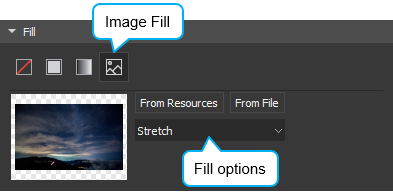
- Stretch: Extend the image to all edges of the container by distorting or shrinking it. Thus, Stretch may only work for some abstract images, non the "figurative" ones. This is the default.
- Center: Center the paradigm within the element. If the image is smaller than the container, you'll see a transparent area around the edges. Otherwise, you'll see the very center of the image, with the rest exterior of view. Choose this for images with the center focus.
- Tile: Repeat the aforementioned epitome throughout the groundwork, making multiple tiles of the image. It is meant for small images or patterns.
- Fit: Scale the prototype equally large as possible without cropping or stretching information technology. By doing then, the whole image is shown. The empty portion of the container is made transparent.
- Fill: Scale the prototype as big equally possible without stretching it. If the proportions of the image differ from the container, the image is cropped so that it covers the entire container.
Making Transparent Groundwork
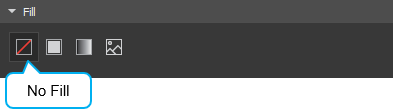
To make transparent background, select No Fill up as the background fill style. You tin also employ solid fill with 0 alpha or prepare the Opacity property value to 0%.
That's all nigh background make full in Saola Animate. Hope that this helps.
Source: https://atomisystems.com/html5-animation/saola-animate-2/set-background-fill-styles/
Posted by: thomascuslichavy.blogspot.com
0 Response to "How To Change Background Color In Adobe Animate"
Post a Comment